
Cannabis Licensing Pathway: When Real Estate Enters The Picture
An educational guide for cannabis operators, multi-state operators (MSOs), and nationwide aggregator applicants pursuing new licenses, with a focus on Arizona and the Phoenix Valley. This is general information, not legal, licensing, or compliance advice.
Why real estate comes first (or almost always early)
Many operators treat real estate as a "post-award" task: win the license, then go find a building. In most sophisticated markets the order runs the other way. Real estate enters earlier than operators usually expect.
The application usually needs an address. Many states and cities require a specific property to be identified on the license application, and many also require proof that you control it (a deed, a signed lease, or an executed letter of intent or option).
Zoning clearance comes before, or as a condition of, the license. In most markets the local jurisdiction must confirm that cannabis use is allowed at that exact address before the state will issue, or finalize, a license.
Compliant sites are scarce. Buffer rules, zoning districts, and caps on the number of locations shrink the pool of eligible properties. When an application window opens, every applicant is chasing the same short list.
Starting real estate late is a common failure mode. Applicants who wait until the window opens often end up with no qualifying site, a site that fails a buffer once it is surveyed, or a lease that never allowed cannabis in the first place.
Pathway at a glance
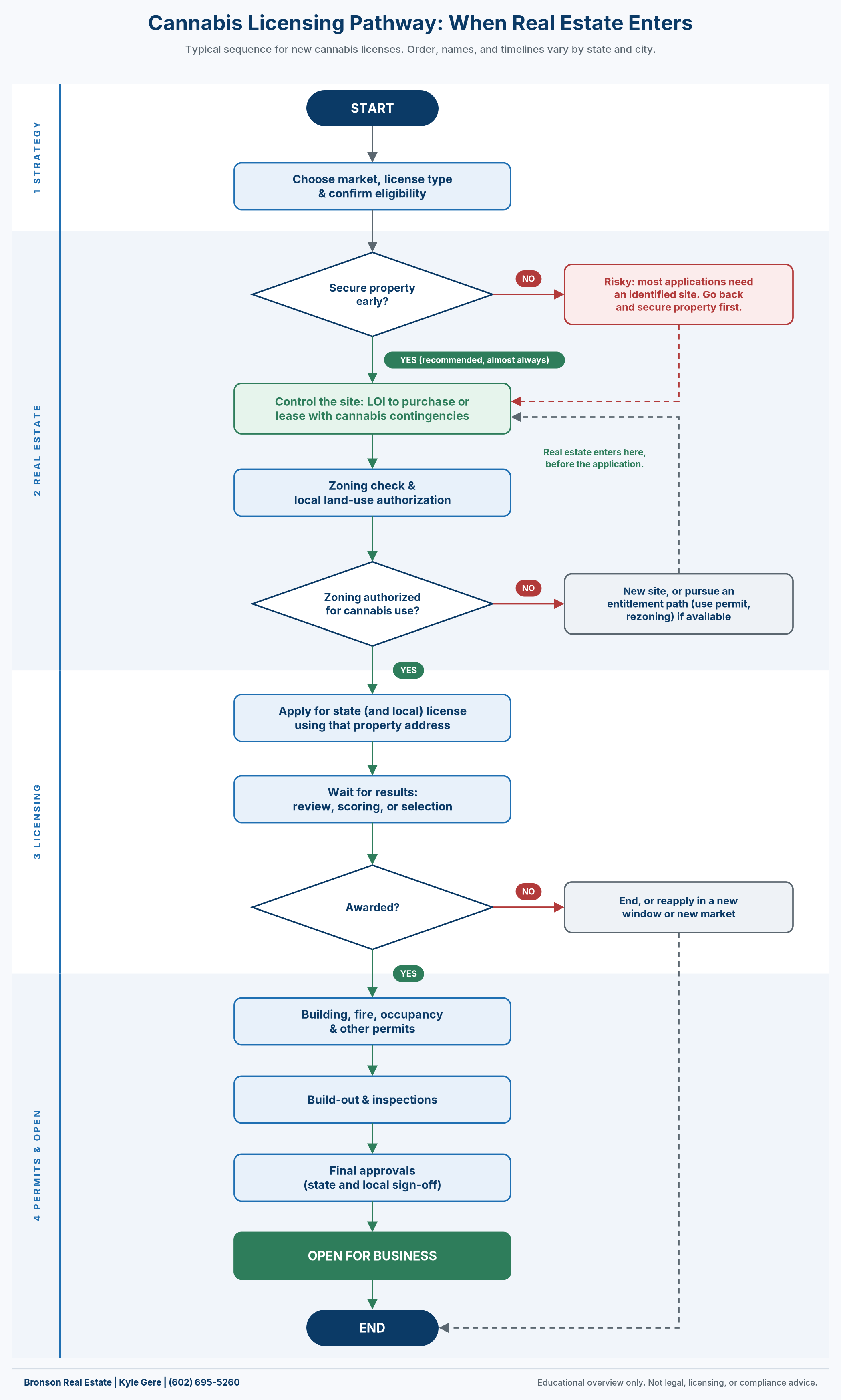
The licensing pathway, step by step
Decide license type, market, and eligibility. Confirm which jurisdictions are open, which license types are available, and whether your ownership group qualifies (residency, social equity, ownership limits, background requirements).
Secure local property early. Tie up a site with an LOI to purchase or a lease agreement that includes cannabis contingencies. If you skip this step, most applications stall or fail completeness review.
Secure zoning authorization or local land-use approval for that address. This may be a zoning verification letter, a use permit, a development review approval, or a local cannabis permit. If zoning does not authorize the use, find a new site or evaluate an entitlement path (use permit or rezoning) where one exists.
Apply for the state (and any local) license using that property address. The site, the floor plan, and the security plan are often part of the application itself.
Wait for license results, scoring, or award. Depending on the jurisdiction this may be merit scoring, a lottery or random selection, or a first-come review. If you are not awarded, the path either ends or you reapply in a new window or a new market.
Obtain building, fire, occupancy, and other permits. Tenant improvement plans, fire and life-safety review, and any health, signage, or utility approvals.
Build-out, inspections, and final approvals. Construction, local inspections, state pre-operational inspection where required, and final sign-off.
Open and commence operations. Many jurisdictions set a deadline to become operational after award, so a slow build-out can put a license at risk.
LOI, purchase, and lease tips for cannabis sites
A cannabis LOI or lease should be written around the licensing timeline, not a standard retail or industrial timeline. Points to raise with your attorney and the landlord or seller:
Express cannabis use clause. The lease or purchase agreement should clearly permit the specific licensed cannabis use (retail, cultivation, manufacturing, and so on). A general "any lawful use" clause is not enough, because cannabis remains illegal under federal law and many landlords and lenders treat it differently.
Zoning contingency. The right to terminate, or to recover deposits, if the property cannot obtain the required zoning verification, use permit, or local approval within a set period.
License-award contingency. The right to exit if the license is not awarded, or a structure where rent or closing does not start until award.
Timeline alignment with application windows. Match due diligence, option periods, and closing or rent start to the application deadline and the expected award date. Build in extensions in case results are delayed.
Exclusivity. Ask the owner to stop marketing the property to other cannabis applicants during your option or LOI period. Competing applicants often target the same compliant sites.
Assignment rights. Make sure the LOI or lease can be assigned to the licensed entity, an affiliate, or a new owner, since applicant entities often change during the process.
Option or holding structure. A paid option, holding deposit, or reduced "pre-award" rent can control the site without full lease costs before you know the outcome.
Landlord cooperation. Many applications require a landlord consent, signature, or affidavit. Put that obligation in writing.
Buffer and survey verification. Order a professional distance survey early and tie it to your contingency period.
Build-out and security rights. Confirm the right to install security systems, vaults, HVAC, odor control, and power upgrades the license will require.
Zoning authorization before you apply
Zoning is local, and in most markets the license depends on it. Before committing to a site, confirm:
Is cannabis allowed in this jurisdiction at all? Many cities and counties ban some or all license types, or have moratoriums in place.
Which zoning districts allow the use, and how? As-of-right, with a use permit, or only in a special overlay.
Distance and buffer rules. Common buffers include schools, churches, parks, daycares, residential districts, treatment facilities, and other cannabis businesses. How distance is measured (property line to property line, door to door, or straight line) can decide whether a site qualifies.
Overlays and caps. Some cities limit the number of locations, restrict hours, or add design and signage standards.
For the general zoning process (research, permitted uses, use permits, variances, rezoning, hearings, and appeals), see our companion guide: Understanding Zoning Before You Buy, Lease, or Change Use.
What operators and nationwide aggregator applicants should look for in a new license opportunity
Before committing time and capital to a new license round, run the opportunity through this checklist:
Jurisdiction openness. Has the state and the specific city or county opted in, or does it ban the license type? Is there a moratorium? Is it a defined application window or rolling applications?
License type fit. Retail, cultivation, manufacturing or processing, testing, delivery, transport, microbusiness, or a combined or vertically integrated license. Availability and rules differ widely from state to state.
Scoring or selection criteria. Understand how awards are decided: merit scoring, lottery, or first-come. Common scoring factors include social equity status, residency, capital, operating experience, security plan, community benefit, and local hiring.
Capital readiness and proof of funds. Many applications require proof of funds or liquid capital, plus enough runway for rent or carrying costs, build-out, and a long pre-revenue period.
Controllable real estate that meets zoning and buffer rules. A site you can actually control, in an allowed zoning district, that survives a professional buffer survey.
Ownership, ownership disclosure, and background check readiness. Principals, investors, and sometimes lenders may need to disclose ownership, submit fingerprints, and pass background checks. Know the ownership thresholds that trigger disclosure.
Local goodwill. Host community agreements, neighborhood or community meetings, council support, and local letters of support can matter in scoring and in local approvals.
Timeline realism. From site hunt to opening, 18 to 36 months is common, and some projects take longer. Ranges vary widely by state, city, and license type.
Risks aggregators often miss
Non-transferable licenses. Some jurisdictions prohibit selling or transferring a license, or restrict transfers for a period after award.
Change-of-control rules. Bringing in investors, selling equity, or restructuring may require regulator approval and can trigger new disclosures.
Local veto after state award. A state license does not guarantee local approval. A city can still deny the use permit or required local license.
Lease without a cannabis use clause. A landlord, lender, or HOA can block the use if the lease never expressly allowed it.
Property that fails buffers after survey. A site that looked compliant on a map can fail once a professional survey measures it under the jurisdiction's actual method.
Location-locked licenses. Some licenses are tied to the approved address, so relocating later may require a new approval process.
Operational deadlines. Missing a deadline to become operational after award can put the license at risk.
Arizona note
Arizona legalized adult-use cannabis through Proposition 207, the Smart and Safe Arizona Act, approved by voters in November 2020 and codified in Arizona Revised Statutes Title 36, Chapter 28.2. The Arizona Department of Health Services (ADHS) licenses and regulates marijuana establishments.
Local control is real. Cities, towns, and counties may prohibit marijuana establishments or regulate them through reasonable zoning and land-use rules, including districts, separation distances, and permit requirements. Rules in Phoenix, Mesa, Tempe, Scottsdale, Glendale, and unincorporated Maricopa County differ.
An ADHS license does not override zoning. A state license does not give you the right to operate at an address the local jurisdiction has not approved. Local zoning and building approvals are still required.
New license opportunities are limited. The number of licenses is capped, and some recent Arizona license rounds have used random selection rather than merit scoring. Availability, fees, and requirements change, so confirm current rules directly with ADHS and the local jurisdiction.
Rules outside Arizona vary by state and city. Treat any general statement in this guide as a starting point, not a rule for your market.
Work with a cannabis real estate advisor early
If you are evaluating a new license opportunity in Arizona or the Phoenix Valley, bring real estate into the conversation at the strategy stage, before the application window opens. I help operators, MSOs, and aggregator applicants identify compliant sites, screen zoning and buffer issues, and structure LOIs and leases around licensing contingencies.
Kyle Gere, Realtor®
Bronson Real Estate | HomeSmart
Commercial and cannabis real estate advisory
Call or text: (602) 845-0820
